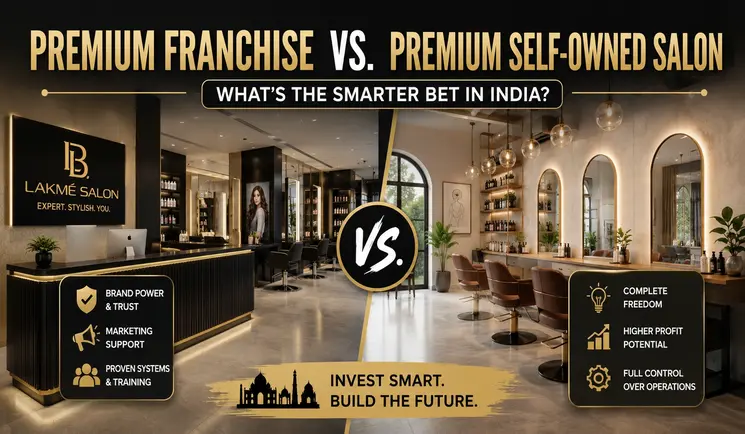
Premium Franchise vs. Premium Self-Owned Salon: What’s the Smarter Bet in India?
India’s premium salon market is expanding rapidly, fueled by aspirational consumers, higher spending power, and a growing preference for branded, experience-driven services. For entrepreneurs entering this segment, the biggest strategic decision is clear:
Table Of Content
- Should you invest in a premium franchise or build your own premium salon brand?
- Understanding the both the Models
- Premium Franchise Salon
- Common Ownership Models
- Premium Self-Owned Salon
- 1. Market Acceptance & Brand Trust
- 2. Investment & Cost Structure
- 3. Training & Skill Development
- 4. Operations & Management Complexity
- 5. Revenue Potential & ROI
- 6. Marketing & Customer Acquisition
- 7. Sustainability & Scalability
- 8. Challenges in Both Models
- 9. Opportunities in the Premium Segment
- Final Verdict: Which One Should You Choose?
- Choose a Premium Franchise if
- Choose a Self-Owned Salon if
- Conclusion
Should you invest in a premium franchise or build your own premium salon brand?
Both models can be profitable—but they come with very different realities in terms of control, cost, risk, and scalability.
Understanding the both the Models
Premium Franchise Salon
A franchise involves partnering with an established brand like Toni & Guy, Lakmé Salon, or Looks Salon, where you operate under their brand name, systems, and standards.
Common Ownership Models
FOFO (Franchise Owned, Franchise Operated): The most common model, where the brand provides branding and training, but you manage daily operations. (e.g., Looks Salon, Bellance, Geetanjali, VLCC etc.)
Key Aspects of the Salon FOFO Model:
- Ownership & Management: The franchisee is fully responsible for daily operations, inventory, and staff management.
- Investment: The franchisee bears the full cost of setting up the salon.
- Royalty Fees: The franchisee pays a monthly royalty fee to the franchisor, often 5%–10% of net revenue, or sometimes a fixed fee.
- Flexibility: Allows local customization to suit customer preferences while using the parent brand’s reputation.
- Risk & Reward: Higher profit potential compared to the FOCO model, but the franchisee bears all operational risks.
COCO (Company Owned, Company Operated): Used by some brands for flagship locations. (e.g., Lakme Salon, Geetanjali, Naturals Salon, Green Trends etc.)
Key Aspects of a COCO Salon Example:
- Ownership: The brand (e.g., a premium chain like Naturals or a corporate-owned flagship) owns the furniture, salon equipment, products, and leases the space.
- Operations: All staff are trained directly at the brand headquarters to maintain uniform service standards.
- Profit & Loss: The parent company bears the expenses of rent, staff salaries, marketing, and operational losses.
- Expansion: Often used for expanding into new, high-prestige locations where brand image is crucial.
FOCO (Franchise Owned, Company Operated): The investor funds the setup, but the franchisor manages operations (e.g. Signature Salon India, Toni & Guy, Lakme Salon etc.)
Key Characteristics of FOCO Salon Model:
- Investment: Franchisee pays for interior setup, inventory, and security deposits.
- Operations: The brand (franchisor) manages staff, training, inventory, and services.
- Returns: Usually a guaranteed fixed monthly income or a revenue-sharing model, reducing operator risk.
Premium Self-Owned Salon
This is an independent salon built from scratch—your own brand, your own identity, your own strategy.
1. Market Acceptance & Brand Trust
Franchise Model:
- Immediate brand recognition
- Faster customer acquisition
- Easier trust-building in premium markets
Self-Owned Model:
- Requires time to build credibility
- Depends heavily on marketing and word-of-mouth
- Slower initial traction
Reality Check:
In cities like Mumbai and Delhi, brand perception plays a huge role. Customers often prefer known names when paying premium prices.
2. Investment & Cost Structure
Franchise
- Investment: ₹60 lakhs – ₹2 crore
- Franchise fee + royalty (5–15%)
- Mandatory interior & design standards
- Centralized product sourcing
Self-Owned
- Investment: ₹40 lakhs – ₹1.5 crore (flexible)
- No royalty
- Freedom in vendor selection
- Customizable interiors
Key Insight:
Franchises have higher structured costs, while self-owned salons offer cost flexibility but require smarter planning.
3. Training & Skill Development
Franchise Model:
- Structured training programs
- Standardized SOPs
- Continuous upskilling support
- Access to global techniques (especially brands like Toni & Guy)
Self-Owned Model:
- You must build your own training system
- Hiring skilled stylists becomes critical
- Higher dependency on individual talent
Challenge:
In India, skilled manpower is one of the biggest bottlenecks. Franchises solve this faster.
4. Operations & Management Complexity
Franchise:
- Proven business model
- Defined pricing and services
- Operational support provided
Self-Owned:
- Full control over pricing, services, and branding
- Requires strong operational expertise
- Trial-and-error phase is longer
Truth:
Franchise reduces execution risk, while self-owned increases strategic flexibility.
5. Revenue Potential & ROI
Franchise Model
- Faster break-even (18–30 months)
- Higher customer inflow due to brand recall
- Lower experimentation risk
Self-Owned Model
- Slower initial growth
- Higher long-term profitability (no royalty)
- Strong margins once brand is established
Example Insight:
In a market like Bangalore, a well-positioned independent salon can outperform franchises after 2–3 years if branding is done right.
Also Read:- Premium Salon Market in India: Why Bangalore is Leading the Growth Story
6. Marketing & Customer Acquisition
Franchise:
- National campaigns
- Social media & influencer collaborations
- Launch support
Self-Owned:
- Full responsibility of marketing
- Requires strong digital strategy
- Higher initial customer acquisition cost
Opportunity:
Self-owned brands can build hyper-local loyalty and niche positioning faster if executed well.
7. Sustainability & Scalability
Franchise Model:
- Easier to scale (multi-unit expansion)
- Consistent brand systems
- Lower brand-building effort
Self-Owned Model:
- Harder to replicate initially
- Requires brand-building investment
- Higher long-term valuation potential
Strategic View:
Franchise = Operational scalability
Self-owned = Brand equity creation
8. Challenges in Both Models
Franchise Challenges
- Limited creative control
- Ongoing royalty payments
- Dependence on brand decisions
- High compliance requirements
Self-Owned Challenges
- Brand building takes time
- Talent acquisition and retention
- Trial-and-error in pricing/services
- Higher initial risk
9. Opportunities in the Premium Segment
Regardless of the model, the premium salon space offers strong opportunities:
- Rising demand for skin & hair treatments
- Growth in male grooming (20%+ contribution)
- Bridal and event-based revenue spikes
- Expansion into spa & wellness services
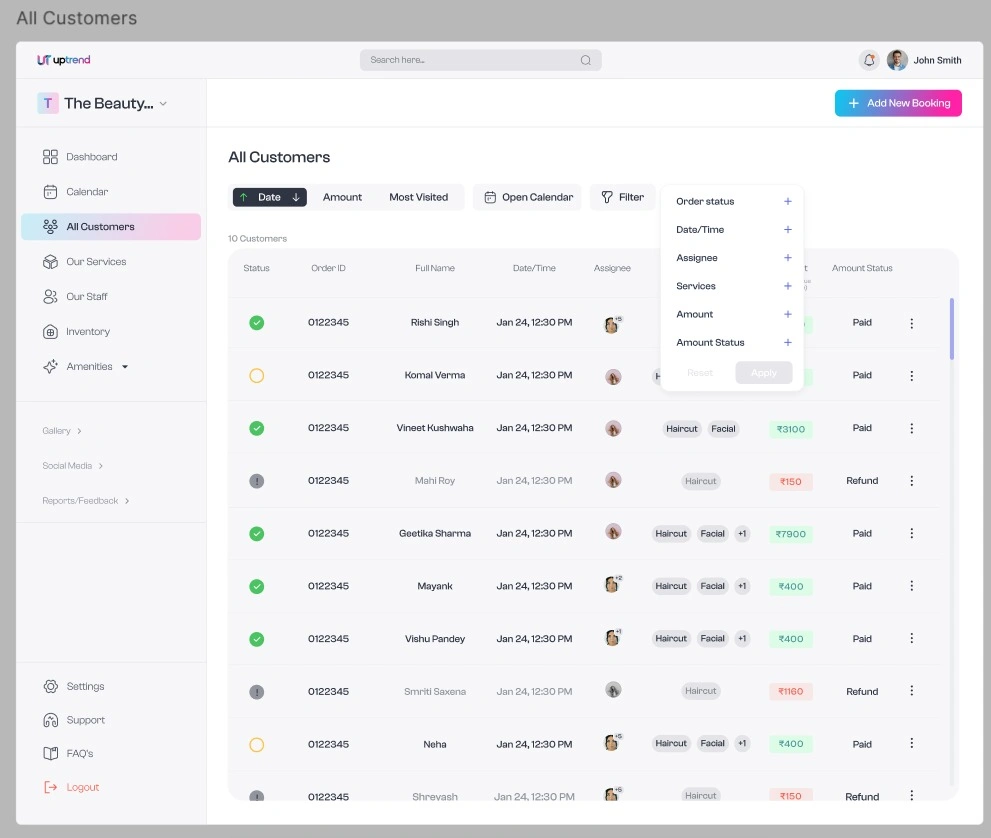
- Integration with digital platforms (appointments, memberships)
Final Verdict: Which One Should You Choose?
Choose a Premium Franchise if:
- You want faster market entry
- You prefer structured systems and support
- You are investing in metro cities with high competition
Choose a Self-Owned Salon if:
- You want to build a long-term brand
- You have industry expertise or strong team
- You are ready to invest in marketing and differentiation
Conclusion
There is no one-size-fits-all answer. The right choice depends on your risk appetite, capital, experience, and long-term vision.
- Franchise gives you speed and stability
- Self-owned gives you freedom and long-term upside
In India’s fast-growing premium salon market, both models can succeed—but only with clear positioning, strong execution, and deep understanding of customer expectations.
For more business and market insights, please contact us.
Contact Us
📲 Instagram: @uptrendindiaofficial & @uptrend_partners
Author: Tazul Haque, Founder & Wellness Business Strategist